What are GCSE English Examiners Really Looking For?
For many students, GCSE English can feel a bit like trying to guess what’s going on inside the examiner’s head.
Unlike maths or science, there isn’t usually one single “correct” answer to the reading questions. Two students can read exactly the same extract and write completely different responses, yet both can achieve high marks. The writing tasks can feel just as daunting. What makes a description engaging? How do you write a story that captures the examiner’s attention? How can you produce a thoughtful article or speech in just 45 minutes?
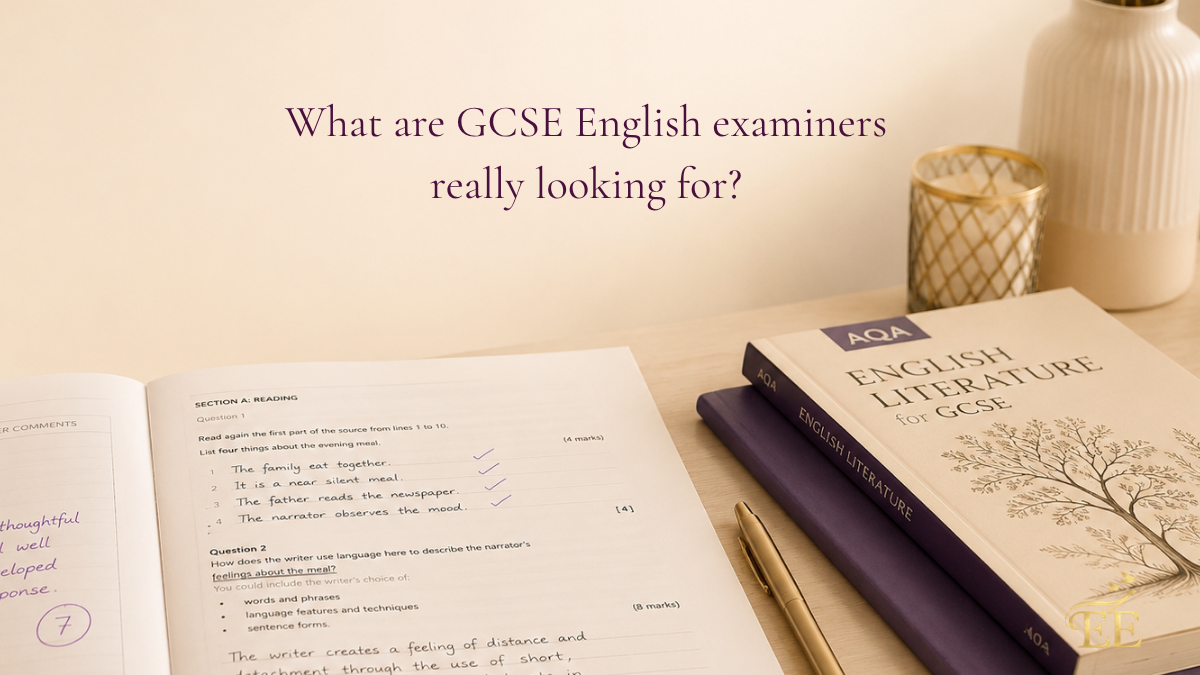
The good news is that examiners aren’t looking for mind readers. They’re looking for evidence that students have understood the text, thought carefully about it and communicated their ideas clearly.
After more than 30 years teaching English, and many years working as an examiner and team leader for AQA, I’ve marked thousands of GCSE responses. Over that time, I’ve noticed that the strongest answers nearly always have the same qualities in common.
Examiners reward precision
One of the biggest misconceptions students have is around the word “methods.”
Every GCSE English mark scheme asks students to identify and analyse the writer’s methods. Yet many students choose an excellent quotation and then simply write, “This shows that…”
The problem isn’t that their idea is wrong – it’s that their explanation is often too vague.
The strongest responses are specific. They identify exactly what the writer has done and explain why that particular choice is effective. Rather than stopping at a simple explanation, they develop their thinking and explore how the writer’s choices shape the reader’s understanding.
That level of precision is what helps students move from straightforward responses to the more developed analysis needed for the higher grades.
Examiners reward thoughtful development
One of the biggest differences between lower and higher-mark responses isn’t knowledge – it’s depth.
Students often have excellent ideas, but they stop just a little too soon. They explain what happens but don’t fully explore why it matters or how the writer has achieved their purpose.
Examiners are looking for students who develop their ideas. They want to see thoughtful responses that build on an initial point rather than rushing on to the next quotation.
The encouraging news is that this isn’t a mysterious talent that some students have and others don’t. It’s a skill that can be taught, practised and improved with the right guidance.
Examiners reward purposeful writing
The same principles apply to the writing section.
Examiners aren’t marking whether they personally like your story or agree with your opinion. They’re looking at how the writing has been crafted.
Has the student chosen language carefully?
Do the sentence structures create interest and variety?
Is punctuation being used deliberately for effect?
Does the writing have a clear purpose and engage the reader from beginning to end?
The strongest pieces always feel intentional. Every paragraph has a purpose, every sentence earns its place and the writer is clearly trying to create a particular response in the reader.
The biggest misconception of all…
Perhaps the biggest myth about GCSE English is that examiners are trying to catch students out.
Nothing could be further from the truth.
Examiners are actively looking for reasons to award marks. They want students to succeed. Every mark scheme is designed to reward what students can do, not punish them for what they can’t.
The challenge is making sure students know how to demonstrate what they understand.
Building confidence through structure
One of the reasons many students struggle in exams isn’t because they don’t know enough. It’s because they don’t know where to begin.
Faced with a blank page, it’s easy to panic.
Over the years, I’ve found that giving students a clear structure for approaching each question transforms their confidence. When they know how to get started, how to organise their ideas and what the examiner is looking for, they can concentrate on the thinking rather than worrying about the process.
But here’s the important part: the structure is only the starting point.
The aim isn’t for students to follow a formula forever. The structure gives them confidence. Once they understand what successful answers look like, they become more independent, more creative and begin to develop their own voice.
That’s when English stops feeling like a puzzle and starts becoming something they genuinely enjoy.
If your child is struggling with GCSE English, remember that they aren’t alone—and they’re certainly not the first student to feel this way. With the right guidance, confidence and approach, English can become a subject they enjoy rather than fear.
If you’d like to find out more about how Elevate English supports students, I’d love to hear from you.