GCSE English Literature: Does My Child Really Need to Memorise All Those Quotes?
One of the things I relish about having a good knowledge of many texts under my belt is the fact that, thanks to great writers, I often have a relevant quote for any occasion — to the point that I am often referred to as Rent-a-Quote in our family!
As a wise teacher once said to me when I was a student:
“Having knowledge of such things opens doors for you and you then have a choice of whether to go through the door or not. No knowledge means those doors are always closed.”
All too often, Literature feels like something that is done to students, rather than something that enriches their lives. Great literature allows us to explore human nature and motivation, recognise links between cultures and connect with different times and worlds.
And yet, rather than relishing the stories, one of the first things I often hear from students is the resounding cry:
“I can’t remember all the quotes!”
It’s understandable to feel a sense of panic when thinking that enormous quote banks — or even whole texts — have to be learnt by heart, particularly when the texts aren’t allowed into the exam with you.
The good news is that students don’t have to know every word of every text, nor do they need to recite great chunks of the story in the exam.
What students need is a smaller number of flexible quotations that can earn their keep in almost any essay topic that might come up in the exam.
Understanding where in the text each quotation appears — and why it matters — shows a clear grasp of the writer’s intent. Likewise, being able to make links between characters, themes and the writer’s message for their audience is a key skill.
A good example of how to make a quotation work for you would be:
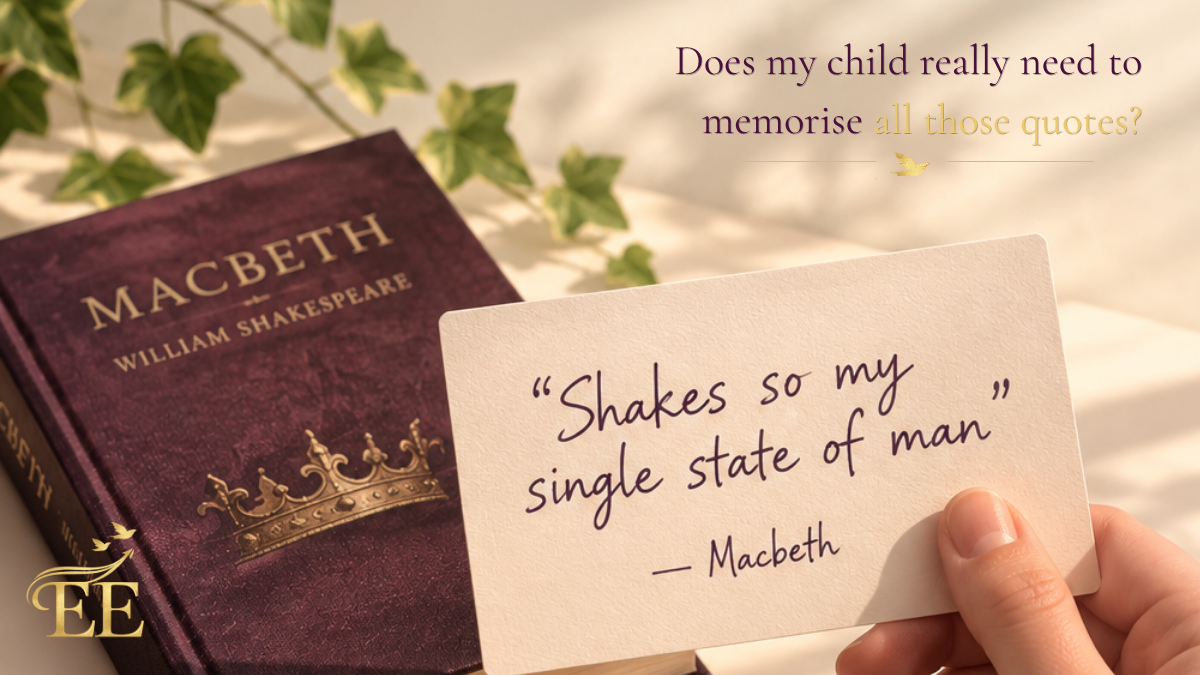
“Shakes so my single state of man”
Those seven words from Macbeth pack a wealth of meaning and opportunity for excellent analysis.
A student can memorise seven words.
Then they can explore the fact that those words occur before Lady Macbeth has any influence over Macbeth, notice the sinister sibilance, connect it with the later serpent imagery and start questioning the simplistic “Lady Macbeth made him do it” interpretation.
That short quotation can be linked to Macbeth’s ambition, his capacity for betrayal and the age-old question of who is to blame.
One quote. Lots of mileage.
I would much rather a student walked into an exam with ten quotations they really understood than fifty quotations they had memorised but didn’t know what to do with.
The question I hear most often from parents is:
“So, how can I help at home?”
You don’t need to turn your kitchen into an English classroom — and you certainly don’t need to become Rent-a-Quote yourself!
Simply asking your child to tell you one quotation they know, then prompting them with:
“Why does that quote matter?”
can be much more useful than asking:
“Can you remember it?”
Remember, your job isn’t to mark the response.
It’s to get your child talking about the quotation rather than merely reciting it.